What You Need to Know Before Your First Visit to Athens
Athens is a city where ancient history literally surrounds you—marble columns rise above modern cafés, and you can walk from a 2,500-year-old temple to a buzzing neighborhood full of street art in minutes. For first-timers, the appeal is straightforward: world-class archaeology, excellent food, walkable neighborhoods, and a Mediterranean energy that makes even jet-lagged travelers feel alive. But Athens also rewards planning. The city gets very hot in summer, very crowded in peak season, and some neighborhoods are safer and more tourist-friendly than others. This guide cuts through the noise and tells you where to actually go, what to realistically spend, and how to avoid the most common first-timer mistakes.
The Must-See Ancient Sites
The Acropolis is unavoidable and unmissable. Yes, it's crowded. Yes, there's a steep entry fee (around €20). But standing at the Parthenon with the entire city sprawling below you justifies both. Arrive by 8 a.m. or after 4 p.m. to beat crowds. Wear comfortable shoes—the ancient stone is uneven—and bring water.
The Acropolis Museum, at the base of the hill, is excellent and air-conditioned. Many visitors spend 2–3 hours here and find it equal to or better than the outdoor ruins themselves. The top-floor glass floor lets you look directly up at the Parthenon while examining artifacts.
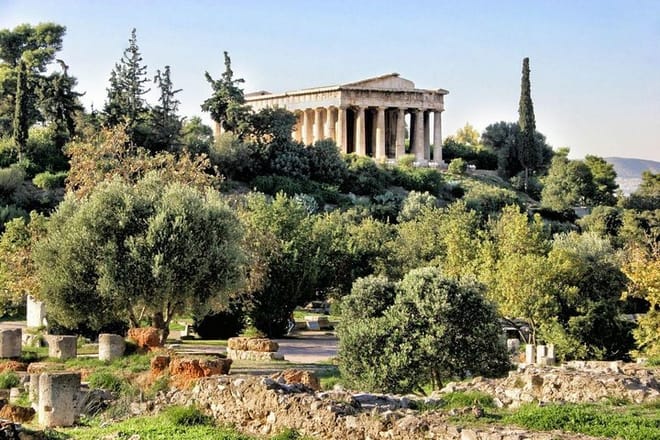
Beyond the Acropolis, the Ancient Agora (the old marketplace and political heart of Athens) is less crowded and gives real flavor to how ordinary Athenians lived. The Temple of Olympian Zeus is photogenic and less mobbed. Both are included in the same multi-site ticket as the Acropolis (roughly €30 for all sites), valid 5 days.
Plaka is the most famous old quarter—a warren of narrow streets, neoclassical buildings, tavernas, and souvenir shops. It's touristy, but that's partly because it's genuinely charming. Eat dinner here at least once. Wander off the main pedestrian drag (Pandrosou and Adrianou streets) to find quieter spots.
Psyrri, just northwest of Plaka, is grittier, with excellent street art, indie boutiques, hole-in-the-wall eateries, and a younger crowd. It feels like the real Athens. Great for lunch and afternoon wandering.
Exarcheia is bohemian and countercultural—full of political graffiti, used bookshops, and cheap tavernas frequented by students and artists. It's edgier than Plaka or Psyrri but safe; just be aware of its political nature and avoid large protests (rare but possible).
Kolonaki is affluent and upscale, home to designer shops, galleries, and expensive cafés. The Benaki Museum and Museum of Cycladic Art are here. If you enjoy high-end shopping and don't mind spending more on food, it's worth an afternoon.
For a structured introduction to the city's best sites and neighborhoods, the Best of Athens in a Fast Tour is ideal if you only have one day.
Food & Eating
Greek food in Athens is straightforward and excellent. You'll find souvlaki (meat skewers), moussaka (layered eggplant and meat), spanakopita (spinach pie), fresh salad with feta and olives, and grilled fish everywhere. Eat lunch around 2 p.m. and dinner after 9 p.m.—this is how locals do it.
Avoid tourist traps near major sites; walk 5–10 minutes away and quality jumps while prices drop. A proper taverna meal with wine costs €12–20 per person. Street food—souvlaki, gyros, loukoumades (honey puffs)—is €3–6 and genuinely delicious. For budget strategies and realistic costs, our guide on Athens on a Budget has specific neighborhood recommendations and price breakdowns.
Practical Logistics
Getting Around: The metro is cheap (single ticket €1.40), efficient, and covers most areas. Taxis are inexpensive but often chaotic; use Uber or Beat (the local Uber equivalent) if you prefer predictability. Walking is often faster than traffic.
Best Time to Visit: April–May and September–October are ideal—warm, not scorching, fewer crowds than July–August. If you visit in July or August, expect 35°C (95°F) heat, massive crowds, and inflated prices. Our Best Time to Visit Athens guide breaks down each season in detail.
How Long to Stay: Three full days is the realistic minimum for first-timers. Two days covers the Acropolis, Acropolis Museum, one or two neighborhoods, and a meal or two. Four or five days lets you breathe, take a day trip to nearby classical sites, and actually feel the city. For more detail, check How Many Days Do You Need in Athens.
Budget: Budget €80–150 per day for accommodation (mid-range), €20–40 for food, €10 for transit, and €20–30 for museum/site entries. A comfortable trip without luxury costs €130–220 daily.
Safety: Athens is generally safe for tourists. Avoid very late-night walks in poorly lit areas and be aware of petty theft on crowded metro lines. Normal travel sense applies.
Day Trips & Longer Exploration
If you have more time, consider a guided day trip. The Corinth Half Day Private Sightseeing Tour covers one of Greece's most significant archaeological sites in a manageable half-day. For serious classical buffs, the 10 Days Private Tour: Peloponnese explores Mycenae, Epidaurus, Sparta, Delphi, and countless smaller sites—a deeper dive into ancient Greece than Athens alone offers.
FAQ
What's the best time to visit Athens for first-timers?
April–May and September–October offer the best balance of warm weather, manageable crowds, and reasonable prices. July and August are extremely hot and peak tourist season; January–February are coolest and quietest but some smaller sites may have reduced hours.
Can I visit the Acropolis and main museums in one day?
Yes, but you'll be rushed. Aim to spend 2–3 hours on the Acropolis, 2–3 in the Acropolis Museum, and maybe 1–2 in the Ancient Agora. Start early and skip lunch or eat quickly. Two days is far more comfortable and recommended.
Is Athens expensive compared to other European cities?
No. Athens is significantly cheaper than London, Paris, or Berlin. Meals, transport, and accommodation all cost less. Museum entries are reasonable (€20–30 for major sites). Budget travelers can eat well for under €30 daily; comfortable travelers should plan €60–100 for food and activities combined.
Where should I stay as a first-timer?
Plaka is convenient but touristy and pricey. Psyrri or Exarcheia offer better value, more authentic atmosphere, and easy metro access to the Acropolis. Avoid very cheap hostels in Omonia; the area is less safe. Mid-range hotels in Psyrri or Monastiraki offer the best balance of price, safety, and walkability.